
AP Photo/Alex Brandon
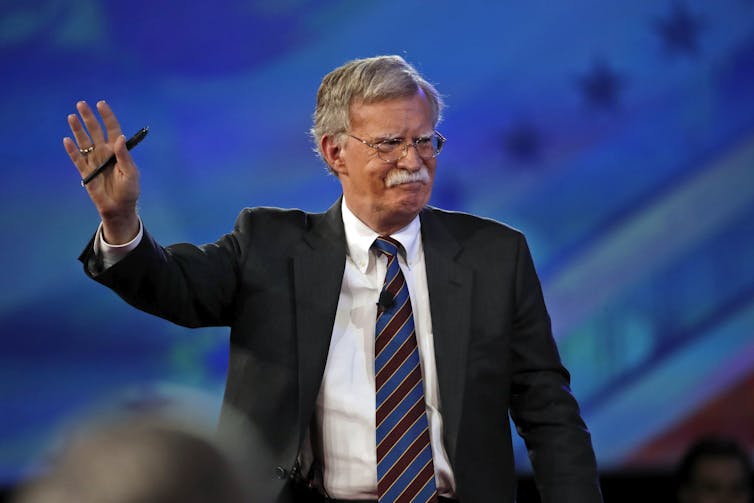
President Donald Trump’s announcement on March 22 that John Bolton would become the new national security adviser took the policy world — and Bolton — by surprise.
Bolton’s hawkish views are well known. During his run as a Fox News commentator, he advocated for and at other times called for .
As a , I occasionally intersected with Bolton while he was U.S. ambassador to the United Nations between 2005 to 2006. His brusque manner and deep mistrust of the U.N. were eye opening. I recall one meeting in which he claimed that a newly formed represented a “conspiracy� that he would uncover in due time. He never followed up with any further information to the best of my knowledge.
Throughout his tenure, he had a with then-Secretary of State Condoleezza Rice and many others at the State Department. After his , I recall that most of his colleagues breathed a sigh of relief upon his exit.
Now as a , I find that Bolton’s promotion to one of the most important jobs in the Trump administration raises critical questions: What is Bolton’s worldview? And is his aggressive posturing on Iran and North Korea hyperbole, or do they represent a real template for new policies? If Bolton’s policy decisions start to match his rhetoric, then the possibility of war may become very real.
Bolton’s hard-line perspective
U.S. foreign policy experts tends to fall into three camps: . Realists view international relations as a competition for power among self-interested states. Liberalists contend that economic integration between nations, international institutions and democracy can overcome selfish state behavior. Idealists believe that international politics are shaped by collective ideas, values and principles.
Bolton nominally falls into the realist camp, but he inhabits the extreme end of it — he is a hard-liner and a hawk. He reflexively distrusts diplomacy to settle disputes. He believes that force and coercion are preferable means to advance U.S. interests. Bolton as a series of “â€� struggles where military force is the deciding factor.
Throughout his career, he has advocated for force over negotiation, often with disastrous results. While serving as the undersecretary for arms control in the Bush administration, for example, he played a key role in related to alleged weapons of mass destruction in Iraq. He not only declared his confidence that such weapons existed, but , “If Saddam Hussein does not co-operate we have made it clear this is the last chance for him.�
As history shows, Saddam , but the United States went to war against Iraq anyway. Bolton’s more recent echoes the past. He has called for Trump to “� the Iran nuclear agreement, and to use bombs and missiles to accomplish U.S. security objectives. As Bolton : “Time is terribly short, but a strike can still succeed.�
What does Bolton want?
Bolton believes that force alone will ensure continued U.S. dominance in the international system. He sees diplomacy and negotiations, particularly through the U.N., as a tactic for weak states to tie the hands of stronger states. He has that negotiations, such as over North Korea’s nuclear program, are a waste of time, and that treaties are “essentially only political documents.�
At his core, I believe Bolton is concerned with how to maintain U.S. primacy in the face of relative decline. He recognizes the likelihood that the Chinese economy will soon become the , and that economic power is a key component of military strength. Therefore, Bolton maintains that the best way to secure American power is to confront revisionist states – countries such as North Korea and Iran which seek to overturn the status quo order — through military strength, and to from potential peer competitors, like China.
Unlike a classic realpolitik strategist like Henry Kissinger, diplomatic subtlety is not part of Bolton’s playbook. If collateral damage accrues, say from a conflict on the Korean peninsula, I’d expect Bolton would likely say that is the cost of doing business.
How will Bolton manage the bureaucracy?
Many commentators have extolled Bolton’s ability to in support of his objectives. That case may be overstated.
It is true that through determination and bullying during heated interagency battles. But his overall record was underwhelming. Bolton’s reputation was so divisive that both Democratic and Republican senators joined together to block his confirmation as ambassador to the U.N. in 2005. Eventually, the Bush administration resorted to a to get him up to New York.
While working as a diplomat in the U.N., he with his counterparts, particularly Secretary General Kofi Annan. Other countries blithely ignored — if not  — his agenda, leaving him with a sparse list of accomplishments. Said : “Instinctively, he’s a bully. He has succeeded in putting almost everyone’s back up, even among America’s closest allies.â€�
In fact, Bolton’s most lasting U.N. legacy may have been his : “The Secretariat building in New York has 38 stories. If it lost 10 stories today, it wouldn’t make a bit of difference.�
Bolton’s State Department colleagues also , according to The Washington Post. He routinely conflicted with Secretary Rice, and as he approached the end of his tenure, his polarizing attitude had shorn him of allies. Rather than wield unrestrained influence, internal opponents often stymied his priorities. As someone notoriously difficult to work with — including serious allegations of  — Bolton will may encounter substantial friction once he gets in place as national security adviser.
Drumbeat of war?
Some experts argue that under Bolton’s leadership, going to war is , but several factors give pause. Many senior diplomats and military leaders — the checks and balances — have left the administration. There are simply fewer experienced people left in the room to challenge Bolton’s ideas.
In addition, it remains to be seen how Trump’s own impulsiveness, as recently evidenced by his , may affect Bolton. It may turn into what academics call the “.� This occurs when individuals in group settings are reluctant to appear overly cautious. Instead, the most reckless member dominates such groups, causing individuals to take chances they would not otherwise carry forward. Trump’s tendency to take audacious gambles, combined with Bolton’s predisposition to use military force, is what is causing many to fear a heightened risk of international confrontation.
 Appointing a hard-line figure like Bolton signals that Trump is ready to embrace a much more aggressive and volatile foreign policy. The next few months will bring key decisions on Iran and North Korea. Bolton’s leadership will go a long way towards determining whether the U.S. finds itself yet again on the brink of war.
, is the Frank and Bethine Church Chair of Public Affairs & Associate Professor, School of Public Service,
This article was originally published on . Read the .
To send a letter to the editor about this article, submit online or check out our guidelines for how to submit by email or mail.


